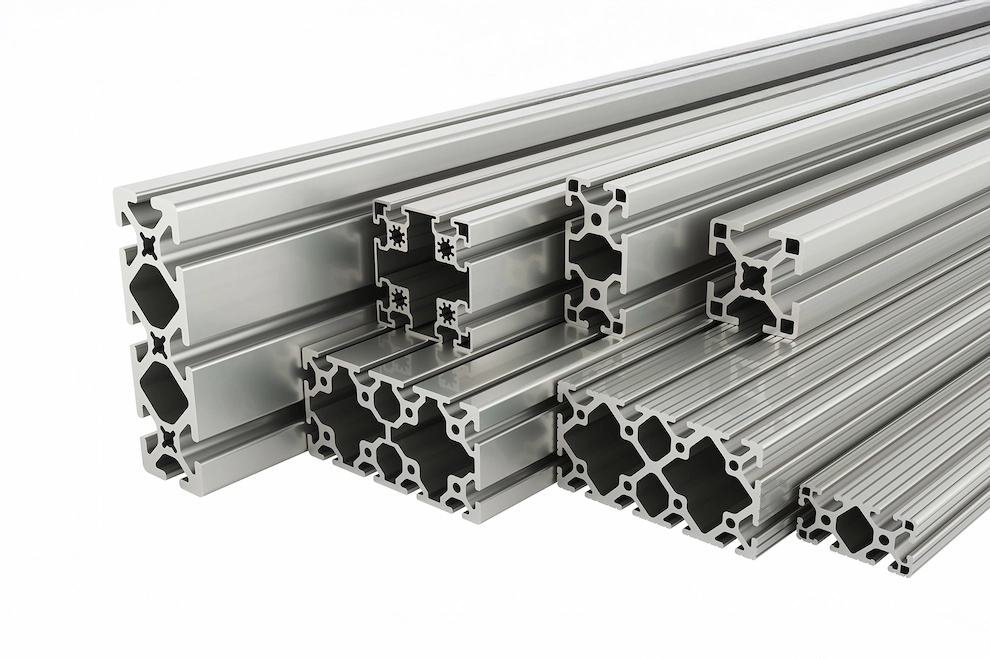
Aluminum sigma profiles are the most practical helper for industrial projects. Thanks to their T-slot design, they are very easy to assemble. These profiles are both lightweight and durable. With their corrosion-resistant structure, they can work flawlessly for years. Engineers and designers love these profiles.
What is an Aluminum Sigma Profile?
An aluminum sigma profile has a cross-sectional shape resembling the Greek letter sigma (Σ). It is a channel-type structural element, typically made using the 6063 series aluminum alloy. This alloy provides durability and machinability.
It is produced using the extrusion method, where aluminum billets are passed through a mold. Common channel widths are 6mm, 8mm, or 10mm. Heat treatment (T5/T6) provides hardness, and anodized coating protects against corrosion. The color options offer an aesthetic appearance.
The natural oxide layer of aluminum provides corrosion protection. Its lightweight structure makes transportation and assembly easy. Even in outdoor conditions, it is long-lasting.
What Does an Aluminum Sigma Profile Do?
Sigma profiles’ T-slots allow for fast assembly with screws, without requiring welding. Their modular structure allows for the rearrangement of systems.
Key advantages include:
- High corrosion resistance, making them suitable for outdoor use.
- The T-slot system easily holds connection elements.
- Aesthetic colors and low maintenance costs.
- Easy recyclability.
- The sigma cross-section distributes loads evenly.
- It simplifies complex projects while ensuring safety.
- Minimal maintenance requirements after assembly.
Aluminum Sigma Profile Sizes and Selection Guide
Aluminum sigma profiles come in a variety of sizes. Popular dimensions include 20×20 mm, 30×30 mm, and 40×40 mm. Rectangular options are also available. The number of channels and wall thickness determine the load capacity. V-slot models are intended for CNC machines.
Selection criteria:
- For small projects, 20×20 or 30×30 mm profiles are sufficient.
- For heavy loads, 40×40 mm and above are suitable.
- For precision work, V-slot types should be chosen.
- Get tolerance and surface coating information from the supplier. High-quality alloys offer long-term savings.
Where Are Aluminum Sigma Profiles Used?
Sigma profiles are used in nearly every industrial sector. Their channel structure is ideal for modular systems:
- Machine Manufacturing: Frame structures and workbenches.
- Automation: Conveyor lines and robotic platforms.
- Exhibition Stands: Quick installation systems.
- Energy Sector: Solar panel frames and greenhouses.
- Electronics: Control panels and cabinet structures.
- Architecture: Shelf systems and decorative partitions.
Their lightweight nature makes transportation easy, while their durability ensures long lifespans, and their recyclable structure is environmentally friendly.
Production and Assembly Process
- Production stages: Aluminum billet → extrusion → heat treatment → anodized coating. Each stage is carefully controlled.
- Assembly: Nuts and bolts are placed into the T-slots. Screwing operations are completed. No welding is required.
- Maintenance: Connection points are periodically checked. Surface cleaning is regularly performed. Anodized coating provides protection.
Reliable Manufacturing: Sistem Aluminum
The quality of sigma profiles depends on the production technology. Sistem Aluminum uses modern extrusion lines and has precise molding and strong R&D capabilities. They perform load testing on every profile.
They offer technical support and custom solutions. Sistem Aluminum ensures durability and aesthetics for projects. They are the right choice for your needs.
With aluminum sigma profiles, your projects become more practical and reliable. The ease of assembly makes a significant difference.